.png?width=110&height=25&name=Natcap_White%20(7).png)
As of early August 2026, Europe is still in the grip of a prolonged heatwave and drought. The European Drought Observatory said conditions in mid-July remained critical across much of the continent and had worsened in central-western Europe, after an extensive heatwave moved from the Iberian Peninsula into central Europe and Italy. In the UK, July 2026 was the driest on record for England and Wales, according to reporting on Met Office data. Across central Europe, the Danube has fallen to exceptionally low levels, disrupting river traffic and power generation. France is battling major wildfires, and the health toll is rising too: WHO/Europe reported that data from five countries already pointed to nearly 10,000 excess deaths linked to heat this summer.
Warnings about food shortages are starting to appear too. But how material is that risk? And which crops are genuinely most exposed?
The short answer is that the risk is real, but uneven. This is not a single story of European agriculture under pressure. It is a more selective shock, with the biggest risks concentrated in crops that were still in sensitive growth stages when heat and water stress intensified. It is also a story about more than yield. In some cases, the more important impact is on quality, reliability and end use.
Why this summer is hitting some crops harder than others
The timing of the heat matters.
Many winter crops, including wheat and barley, were already relatively advanced by the time the worst conditions arrived. They are still exposed to lower yields in some regions, along with shorter grain filling and weaker quality. But the most acute pressure has fallen on summer crops that were still flowering, filling grain or bulking when temperatures rose and soil moisture fell, according to the latest JRC crop update.
That pattern shows up clearly in current EU forecasts. The JRC update projects sunflower yields at 7% below the five-year average, grain maize 6% below, soybeans 5% below, field beans 5% below and potatoes 3% below.
Those are not catastrophic numbers in themselves. But they point to where the pressure is building, and they help identify which commodity chains are most vulnerable if hot and dry conditions continue.
Maize is the clearest area of risk
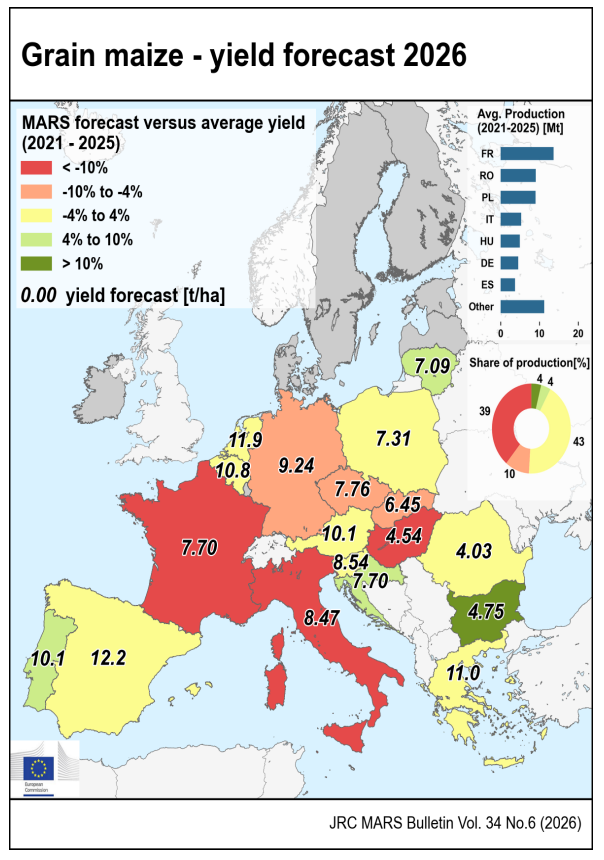
If one crop best captures the commercial risk of this summer, it is maize.
The JRC forecast puts grain maize yields at 22% below the five-year average in Hungary, 15% below in France, 14% below in Italy, 10% below in both Czechia and Slovakia, and 5% below in Germany. That is a meaningful deterioration across several important producing regions.
Maize matters because it runs through multiple supply chains, including animal feed, starch, sweeteners, ethanol and food ingredients. A weak maize season can therefore feed into costs and availability across a wide range of sectors.
There is also a question of use, not only output. The same JRC analysis notes that in Germany some grain maize could be diverted into silage under heat stress. That matters because it changes the mix of supply available to the market. The issue is not simply that there is less crop. Part of the crop may no longer serve the same purpose. Agricultural stress can reduce functional supply before it produces outright shortages.
Sunflower risk is concentrated, not uniform
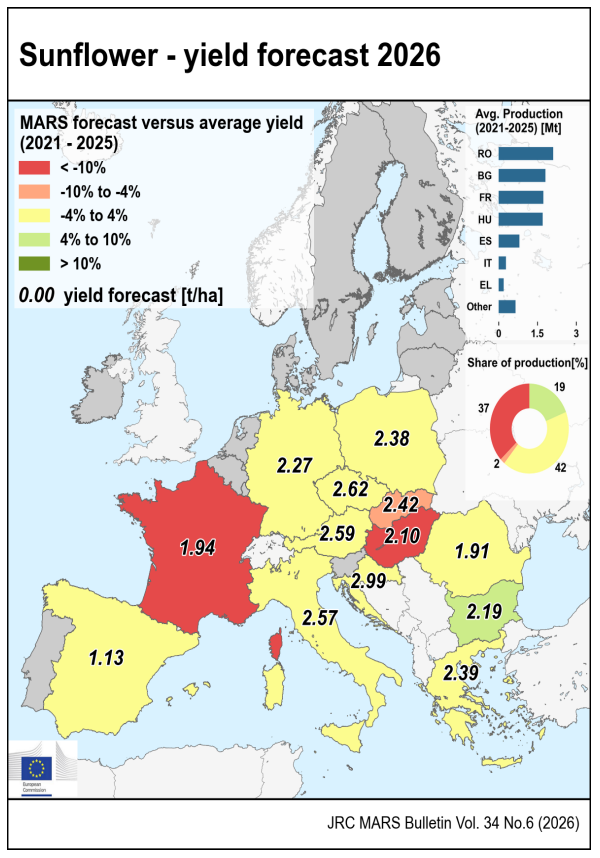
Sunflower is the second crop to watch closely.
At EU level, yields are projected at 7% below the five-year average, one of the largest downward revisions this season. But the impact is not uniform across the EU. Pressure is building in rainfed areas of France and Iberia, while very low soil moisture is affecting crop development in Hungary and neighbouring central European regions.
For businesses exposed to edible oils, biofuels or food manufacturing, that matters because Europe is not behaving as a single production zone. Some regions are under much greater strain than others. That makes sourcing risk more fragmented than a top-line European number suggests.
Potatoes show why quality can matter as much as tonnage
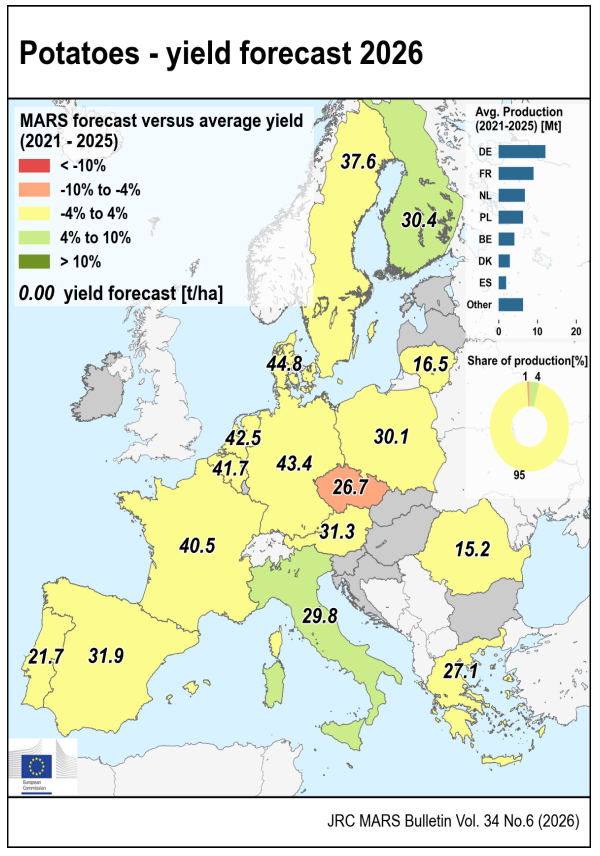
Potatoes deserve more attention than their headline yield number suggests.
At EU level, potato yields are projected at 3% below the five-year average. On paper, that looks manageable. In practice, potatoes can become commercially problematic even when output declines are relatively modest.
The reason is that heat and water stress during tuber bulking can affect size, processing quality and storage performance, as reflected in the JRC’s assessment of heat impacts on summer crops. For growers, that can mean a more difficult season. For food manufacturers, it can mean less consistent raw material, weaker processing performance and higher procurement pressure.
That shifts the problem from the field into the factory. A crop may still be harvested, but it may be less valuable or less useful for the buyer who needs it.
Smaller crops are worth watching too
Soybeans and field beans are both projected at 5% below the five-year average.
These are smaller crops in European terms, but they still matter. They sit inside domestic protein supply for feed and food, and they are part of wider efforts to make supply chains more diversified and resilient. In a stressed season, even relatively small declines can matter if they affect markets where alternatives are already limited or strategically important.
Wheat and barley are not immune
None of this means winter cereals are unaffected.
The JRC update says heat accelerated ripening and shortened grain filling in parts of Germany, Austria, Czechia and Slovakia, raising concerns about smaller grain size and poorer quality. In Germany, some milling wheat may also be downgraded to fodder wheat.
That matters because grain markets are shaped by quality as well as quantity. A harvest can come in without collapsing in volume and still create commercial pressure if more of it slips into lower-value uses.
What this means for supply chains
The most useful question for businesses is not which crop has fallen the furthest. It is where heat, water stress and commercial dependence overlap.
That means looking past headline yield figures and asking more specific questions:
- Which commodities come from the most affected regions?
- How dependent are those supply chains on irrigation?
- Is the main risk lower output, lower quality, or a change in end use?
- How concentrated is sourcing by region or supplier?
- Where could disruption in agriculture spill into transport, energy or processing?
This summer is a reminder that drought is not only an agricultural hazard. It is a system-wide stress that moves through rivers and water systems, into transport and power generation, and then into commodity markets.
The bigger lesson
The risk of food shortages should not be overstated. Europe is not facing a single, immediate collapse in agricultural supply. But the risk should not be dismissed either. What is emerging is more selective and, in some ways, more difficult to manage: weaker yields in the most exposed summer crops, greater regional variability, more quality issues and growing pressure on water-dependent production.
Maize, sunflower and potatoes are the clearest crops to watch this season. They show how environmental risk affects supply chains in practice: not only by reducing what is grown, but by changing how reliable, usable and substitutable that supply really is.
Building the Business Case for Nature in the Food & Beverage Sector
Understand how to go about building the business case for nature and bring other stakeholders across the business - procurement and site managers in particular - along on the process.