
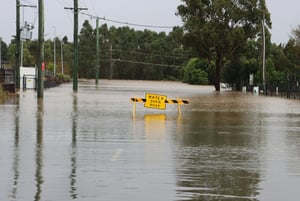
The European Central Bank has warned that banks are likely underestimating physical climate and nature risks on their balance sheets. Because most models miss supply-chain dependencies and economic transmission channels, credit teams cannot rely on high-level sector scores alone. Banks need location-specific evidence that connects environmental disruption to borrower cash flow.
In its November 2026 Supervision Newsletter, the ECB takes a candid look at how European banks are modelling physical hazards. The verdict is sobering. Even as extreme weather and ecosystem degradation hit corporate borrowers harder each year, the tools banks use to measure those shocks still have major blind spots.
For risk and sustainability teams, the article reads less like a routine supervisory update and more like a shift in what regulators will expect next.
Why are banks underestimating physical climate and nature risks?
Most portfolio assessments still stop at direct asset locations or broad sector averages. As the ECB notes, current estimates probably understate the true scale of physical risk because models leave out complex climate mechanisms, incomplete risk drivers, and second-order economic transmission channels.
In practice, a corporate borrower rarely fails simply because a flood hits its headquarters. Trouble starts further upstream. A drought degrades soil fertility in a key sourcing region, crop yields drop, input prices spike, and a mid-market food manufacturer suddenly sees its margins compressed. If a bank is only mapping owned factories or applying generic industry heatmaps, that exposure stays invisible until it shows up in late payments.
The ECB also flags an awkward asymmetry in how banks treat the natural world. Seven of the nine planetary boundaries have now been crossed, yet methodologies, scenarios, and transmission channels for nature risk remain far less mature than those for physical climate risk. At the same time, ignoring how intact ecosystems buffer against floods or heat can distort risk models in the other direction. Either way, flat sector scores leave credit teams guessing.
Why can banks no longer rely on insurance to absorb the shock?
Historically, lenders assumed that physical damage to a borrower’s assets or supply chain would be cushioned by insurance payouts or government disaster relief. The ECB points out that this safety net is fraying.
As severe weather events become more frequent, insurers are raising premiums, narrowing coverage, and pulling out of high-risk geographies altogether. When a borrower loses affordable cover – or faces an uninsured disruption to a critical raw material – physical risk turns directly into credit risk. Banks end up holding residual exposure they never priced into the loan.
What does good practice look like now?
The ECB is clear that banks cannot wait for a single, spotless dataset before acting. Resilience depends on combining better measurement with practical preparation for uncertainty.
From the supervisory dialogue and our work with financial institutions, three shifts stand out for commercial banks:
-
Connect hazard data to actual credit performance. The ECB highlights banks that are linking internal credit data with historical hazard and extreme-weather records to spot early signs of borrower deterioration. Looking at how past droughts or floods affected borrower margins gives risk teams a grounded baseline.
-
Look upstream into counterparty supply chains. Roughly 75% of euro area corporate lending goes to firms heavily dependent on at least one ecosystem service. Banks do not need perfect farm-level traceability for every client to see where risk sits. Combining trade, production, and commodity data makes it possible to pinpoint which borrowers rely on water-stressed or degraded sourcing regions.
-
Translate exposure into financial consequences. A high environmental risk score tells a relationship manager where to look, not what to do. Credit committees need to see the shortest defensible path from an environmental event to a borrower’s revenue, cost of goods sold, operating expenses, and EBITDA – complete with clear assumptions and confidence ranges.
Moving from screening to credit decisions
The ECB’s message is straightforward: physical climate and nature risks are already material financial risks, and the gap between what models capture and what borrowers experience is too wide to ignore.
Banks that treat nature as an extension of their existing credit and physical risk toolkit – rather than a separate box-ticking exercise – will be in a far stronger position to price risk accurately, engage exposed clients early, and withstand supervisory scrutiny.
Want to see how commercial banks are moving beyond sector heatmaps to quantify upstream nature risk across lending portfolios? Explore Natcap’s solutions for commercial banks or speak with our team.