
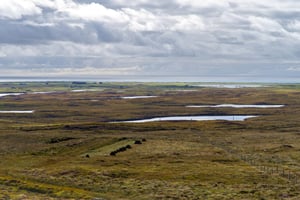
What does restoring a peatland have to do with protecting £1.8 billion in annual water supply revenue?
For United Utilities, potentially quite a lot. The company has invested in peatland and habitat restoration across catchments that supply water to millions of customers and underpin a significant share of its £1.8 billion in annual water supply revenue. These investments aim to strengthen water security and could help avoid tens of millions of pounds in potential storm-damage costs.
Banks are increasingly assessing how nature loss could affect the companies they finance. But while much of the attention has focused on the potential costs of nature loss, companies are already demonstrating the other side of the equation: the commercial value that investing in nature can protect and create.
New research from Natcap and Earth Capital Nexus at the London School of Economics, Understanding Nature's ROI, explores how five leading companies are making that business case.
Protecting value: Investing in resilience
Coca-Cola Europacific Partners (CCEP) has invested in watershed conservation and water replenishment across 11 countries, helping protect water resources critical to its operations and supply chains. The research estimates that water-related risks could affect up to €64 million in annualised operating profit, illustrating the potential financial value of managing these dependencies.
For Mars, the focus is on securing future supply. Its US$1 billion Cocoa for Generations strategy supports agroforestry, deforestation- and conversion-free sourcing, and climate-smart agriculture, aiming to strengthen the resilience of cocoa supply chains central to its business.
While the full financial returns have not yet been quantified, these examples illustrate the commercial rationale for investing in the natural systems underpinning future earnings.
Creating value: Beyond risk mitigation
Consider Bosch. By redesigning its wiper blade packaging, the company eliminated plastic, halved packaging waste and reduced the product's carbon footprint by 24%, without additional costs beyond research and development, thanks to process efficiencies.
Natura illustrates another opportunity. Regenerative production is not simply an environmental commitment for the Brazilian cosmetics company. It has delivered production efficiencies, including higher oil yields and lower fertilisation costs than monoculture systems, while also supporting access to approximately US$258 million in innovative financing to help scale its regenerative ambitions.
What does this mean for financial institutions?
For banks, these examples suggest that assessing nature-related exposure is only part of understanding a company's financial prospects.
The next step is to examine how companies are responding. What investments are they making to protect critical resources and supply chains? What commercial benefits are they expecting? And how are those benefits being measured?
These questions can help banks distinguish between companies with similar underlying exposures but potentially very different levels of resilience. They may also reveal opportunities for cost efficiencies, innovation or revenue protection that warrant consideration in financial analysis. Here is an opportunity to finance commercially credible nature-related investments, helping counterparties strengthen their resilience while potentially developing new lending opportunities.
The question isn't just how much value a company could lose from nature degradation. It's how much it could protect or create by investing in nature.
Explore the evidence in Understanding Nature's ROI, a whitepaper from Natcap and Earth Capital Nexus at the London School of Economics.
Join the authors on a webinar on November 18th, 2026 to learn how to translate nature-related opportunities into compelling investment decisions.