.png?width=110&height=25&name=Natcap_White%20(7).png)
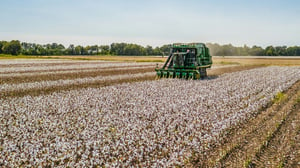
Two companies can source the same commodity and face very different nature-related impacts.
How cotton is irrigated, how cattle are grazed or how a mineral is extracted can materially change the pressures associated with production. Yet most commodity-level environmental assessments necessarily begin with representative or average production data.
That is useful for understanding broad exposure. It is less useful when a company knows more about how its supply chain actually operates, or wants to understand what might happen if it changed.
Natcap’s new commodity production practices capability is designed to close that gap.
From commodities to production practices
A commodity production practice is a specific way in which a commodity is produced, managed or sourced.
Rather than treating every unit of a commodity as environmentally equivalent, Natcap can now represent selected production practices as distinct commodity variants. This allows an assessment to reflect differences in how production is carried out and how those differences affect pressures on nature.
The first release includes production practices across agriculture and mining, including:
- cattle produced using silvopasture;
- palm oil under RSPO;
- lithium produced using direct lithium extraction;
- copper using tailings dewatering and dry stacking;
- sugar cane (raw) produced using subsurface drip irrigation;
- cotton using integrated pest management, subsurface drip irrigation or Better Cotton Initiative practices; and
- wheat using variable-rate precision fertiliser.
These practices can be selected as separate commodity variants within an analysis.
Moving from assessment towards action
The value of greater specificity goes beyond producing a more accurate baseline.
It also makes it possible to ask a more useful question: what could change?
A company may want to understand how its nature-related impacts could differ if it shifted towards another agricultural practice, sourcing model or extraction technique. For example, it may want to assess the implications of moving part of its cotton supply towards drip-irrigated production, or understand how results differ under an alternative production practice.
This can also help companies make better choices about where to act. Environmental strategies inevitably involve trade-offs between risk mitigation, costs and environmental outcomes. Understanding how alternative practices affect the pressures that matter most can help businesses direct investment towards actions that address material risks, while delivering meaningful improvements for nature.
This is an important step in moving environmental analysis closer to real business decisions.
How the analysis works
For an existing commodity, Natcap researches evidence on how a particular production practice changes relevant impact drivers.
The current workflow covers six impact drivers, including water use, land-use change, deforestation and pollution-related pressures. Validated evidence is then reviewed by scientists and incorporated into the platform as a new production-practice-specific commodity variant.
The process combines AI-assisted research with scientific review. AI pipelines help identify and structure relevant evidence more quickly, while scientists remain responsible for quality assurance and validation before outputs are made available for use.
This allows coverage to expand more quickly without removing scientific review from the process.
Built to expand with customer needs
The initial release is only the starting point.
The capability has been designed so that additional production practices can be added for commodities that are already within Natcap’s coverage. That means the analysis can become more specific as customers develop better visibility over their supply chains, or as new sourcing and transition questions emerge.
Because different companies may rely on very different production systems even within the same commodity, this extensibility is important. The library does not have to remain limited to a fixed set of predefined practices.
Over time, this creates the potential to build a much broader library of production practices and transition options.
From identifying risk to choosing what to do about it
Commodity-level analysis can help businesses identify where their most material nature-related pressures sit. Production-practice-level analysis can take that a step further, helping them explore how those pressures might change under different production and sourcing choices.
That brings nature intelligence closer to the point where it can inform investment, procurement and supply-chain decisions, helping companies move from understanding nature-related risk towards deciding what to do about it.
Unlocking Long-Term Budgets for the Nature Positive Transition: A Practical Guide for Sustainability Professionals
Explore the five key steps for building the business case for nature inside large organisations.