3 min read

Women in Science at Natcap

Women in Science at Natcap
6:51

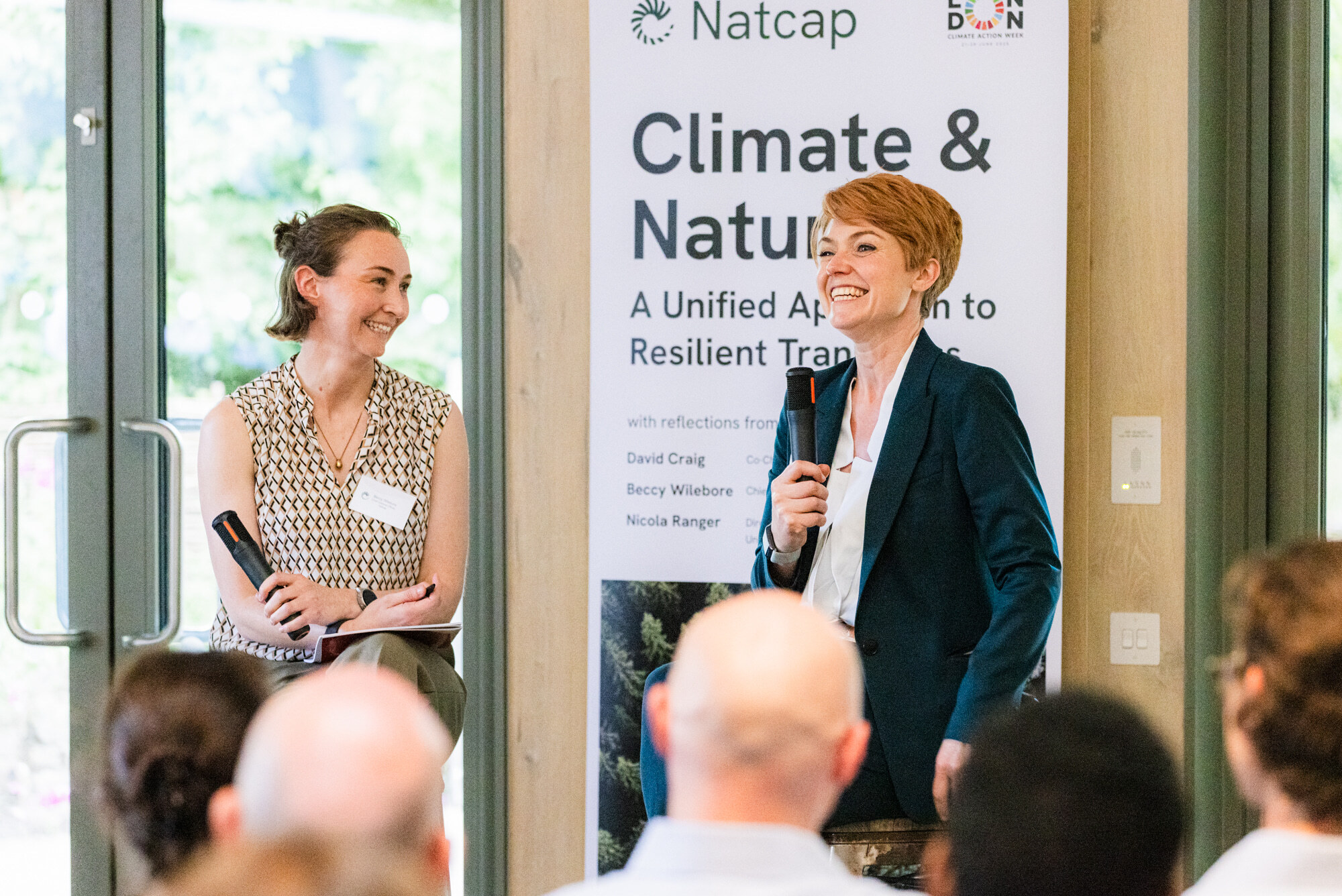
On International Women’s Day, we’re highlighting some of the scientists at Natcap working to better understand business interactions with nature.

Nature is complex, interconnected, and difficult to measure. Understanding it requires expertise across many disciplines, from hydrology and ecology to spatial modelling and remote sensing. The challenge of measuring, interpreting and responding to nature-related risk is becoming increasingly urgent as businesses and policymakers seek better ways to understand and manage their impacts on ecosystems.

We spoke with three scientists at Natcap about how they found their way into nature science, the questions that drive their research, and the places in nature that inspire them most.


Stef Kaupa

Understanding forests, water and ecosystems

Stef’s interest in nature science began during a school exchange in New Zealand.

At the time, she was 15 and encountered something she had never experienced before: outdoor education classes. Instead of being in a gym, physical education took place outside in nature, and the concept of biodiversity was discussed constantly.

The experience shaped her academic interests and led her to pursue biodiversity studies at university. She later enrolled in the only undergraduate programme in Germany that explicitly focused on biodiversity. The course cemented her interest in ecological systems and their dynamics.

Her PhD research explored how land-use change affects landscapes and water cycles. Originally designed as a fieldwork project in Nepal, the research evolved during the COVID-19 pandemic into large-scale modelling using satellite data.

The work focused on a common assumption about nature-based solutions: that planting trees always improves water availability. Stef’s research showed that the relationship is more complex. While reforestation can improve water infiltration into soils and groundwater because of deeper root systems, it doesn’t necessarily increase overall water supply. In fact, only in very humid regions, where trees capture fog, does tree planting significantly increase water availability.

For Stef, science plays an essential role in helping decision-makers understand these complex systems.

Scientific methods allow natural processes to be measured and quantified, helping policymakers and businesses make more informed decisions. Without this understanding, interventions can produce unintended consequences. 

Beccy Wilebore

Bringing disciplines together to solve nature’s toughest problems

Beccy’s interest in nature began early. Growing up in Devon, she spent much of her childhood outdoors, exploring nearby streams and landscapes with her sister. Like many children inspired by David Attenborough, she developed an early awareness that ecosystems were both extraordinary and under threat.

Her academic journey reflected a desire to understand nature from many perspectives. She studied Natural Sciences as an undergraduate, allowing her to explore multiple disciplines before specialising in plant science, a field she values because it connects many areas of biology, from cellular processes to ecosystem dynamics.

During her PhD at the University of Cambridge, Beccy worked on forest conservation in Sierra Leone, collaborating with economists, conservation organisations and local communities. Her research explored whether conservation payments funded by carbon markets could help reduce deforestation while supporting communities living around protected forests.

The findings showed that financial incentives could temporarily reduce deforestation, although the long-term effects were more complex once labour markets adapted to the payments. 

For Beccy, the most exciting aspect of working on nature challenges is the collaboration required to solve them. Addressing nature-related challenges requires collaboration across disciplines, including scientists, software engineers, economists and business leaders.

This combination of disciplines is also central to Natcap’s approach, which brings together scientific expertise, data and software to help organisations understand and manage nature-related risks.

Rhosanna Jenkins

Using models and data to understand nature’s future

Rhosanna’s path into nature science began with a fascination for maps.

Geography appealed to her because it connects visible landscapes with the larger environmental systems shaping them.

Her PhD research focused on southern Kenya, examining how climate change and land use change could affect water resources, biodiversity and agriculture across the region.

Using a combination of environmental models, she projected possible future scenarios up to 2080. The work explored how shifting rainfall patterns and land pressures could create increasing tension between agricultural production, biodiversity conservation and human water needs.

For Rhosanna, science is critical because of the complexity of nature systems. Environmental data can vary widely in quality, and ecosystems respond differently depending on local conditions. Scientific methods help interpret this complexity and ensure decisions about nature — whether in policy or business — are grounded in evidence.

At the same time, she believes we shouldn’t wait for perfect data before acting.
Given the urgency of biodiversity loss and ecosystem degradation, the priority is to use the best available information to guide decisions.

Looking ahead, she is particularly excited about the role of new technologies — including AI — in nature science. Tools that automatically identify species from images or sound recordings could dramatically accelerate biodiversity monitoring, helping connect field observations with real-time insights for conservation and corporate reporting.

Science, collaboration and the future of nature

Although their research spans very different disciplines, these scientists share a common perspective: understanding nature requires collaboration.

Nature systems are deeply interconnected, and solving the challenges facing ecosystems today requires expertise across hydrology, ecology, data science, economics and technology.

At Natcap, that collaboration sits at the heart of the work — bringing together scientific expertise with software, data and business insight to help organisations better understand their relationship with nature.

On International Women’s Day, we’re proud to highlight some of the scientists contributing to this effort.

Their work highlights the role of rigorous science in helping organisations understand how they interact with nature.  

The State of the Corporate Nature Landscape 2025

The State of the Corporate Nature Landscape 2025

In early 2025, we spoke with 13 sustainability leaders across sectors to understand how organisations are engaging with nature. These conversations...

Read More
Investor Expectations on Nature: What Companies Need to Know

Investor Expectations on Nature: What Companies Need to Know

Why ‘Nature’ is on the Investor Agenda Now Sustainability reporting frameworks are multiplying - CSRD, ISSB, TNFD, SBTN, GRI - but investors are...

Read More
Nature Trends for 2025: A Year of Transition

Nature Trends for 2025: A Year of Transition

2025 is poised to be a defining year for the corporate response to nature-related risks. With key reporting frameworks taking effect, global...

Read More