2025 Wrapped: The Year Nature Became Impossible to Ignore
For years, nature-related risk sat in a grey zone - acknowledged, discussed, but rarely acted on. In 2025, that changed. Rules became clearer....
3 min read
.png)
How do you secure long-term corporate budgets for nature? To secure long-term budgets for nature, sustainability leaders must transition from pilot projects to financially credible business cases. This is achieved by identifying specific nature dependencies, quantifying physical and transition risks in financial terms, and integrating nature-based solutions directly into existing enterprise risk management and climate strategies.
The five-step framework for unlocking nature-positive investment involves:
Nature dependencies are the specific ecosystem services—such as water, soil health, and pollination—that a business requires to function. To build a budget case, sustainability teams must move beyond general commitments and map where these services are directly connected to operational performance.
Key areas to evaluate include:
Nature-related risks must be quantified using likelihood and magnitude metrics to be included in capital allocation processes. When risks like water scarcity or regulatory change (transition risk) are translated into potential costs or revenue loss, they become actionable for the CFO.
| Risk Category | Examples | Financial Impact Area |
| Physical Risks | Flooding, soil degradation, water stress | Operating costs, asset values |
| Transition Risks | EUDR, CSRD, litigation, market shifts | Compliance costs, brand equity |
Exhibit: Approach to Likelihood and Magnitude Calculations
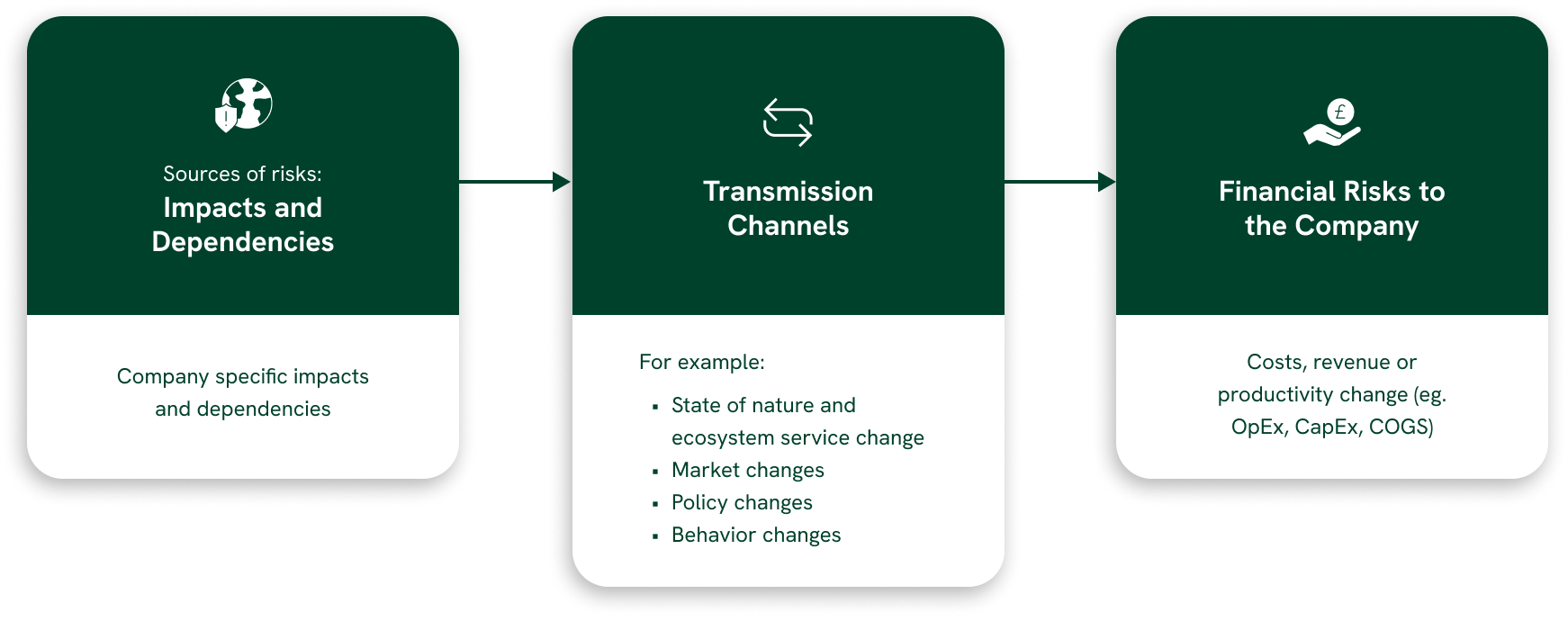
This may involve estimating potential effects on operating costs, input prices, revenue continuity, or asset values.
Scenario analysis can be particularly useful for medium- and long-term risks. For example:
This analysis often reveals opportunity alongside risk — including efficiency gains, supply chain stability, access to premium markets, and enhanced long-term resilience.
Once you have prioritised which risks are most relevant to your organisation, the next step is to think about risk mitigation.
Targeted nature initiatives should address the specific material exposures identified in the previous steps. Rather than a broad list of "green" projects, focus on a portfolio that offers a measurable Return on Investment (ROI) through cost savings or risk reduction.
Effective initiatives often include:
Nature-based solutions are often more successful when integrated into existing corporate priorities like Net Zero or supply chain resilience. By framing nature as a tool to achieve climate targets, sustainability leaders can access existing climate budgets rather than requesting separate funding.
Internal buy-in requires engaging with Finance, Risk, and Procurement teams early in the process. Investment becomes long-term only when it is embedded in the company’s enterprise risk management (ERM) and annual planning cycles.
To ensure sustained investment:
As regulatory pressure from frameworks like CSRD and TNFD increases, nature-related risk is becoming a mainstream financial concern. By following this five-step framework—mapping dependencies, quantifying risk, scoping ROI, linking to climate, and securing buy-in—sustainability leaders can transform nature from a "nice-to-have" into a core strategic investment.
For a deeper exploration of the methodologies, financial translation approaches, and governance mechanisms behind this framework, download the full white paper: Unlocking Long-Term Budgets for the Nature Positive Transition.

For years, nature-related risk sat in a grey zone - acknowledged, discussed, but rarely acted on. In 2025, that changed. Rules became clearer....

2 min read
How do companies translate nature impacts into transition risks? Companies translate nature impacts into transition risks by linking environmental...
.jpg)
Why ‘Nature’ is on the Investor Agenda Now Sustainability reporting frameworks are multiplying - CSRD, ISSB, TNFD, SBTN, GRI - but investors are...