5 min read

Nature-related risk is often associated with companies’ dependence on water, healthy soils or functioning ecosystems. But risk can also emerge from the impacts a business has on nature.
3M’s experience with per- and polyfluoroalkyl substances, or PFAS, is a particularly significant example. Chemicals valued for their durability and resistance to water, heat and oil have become associated with widespread contamination, regulatory intervention and litigation. (US EPA)
The financial consequences are substantial. 3M has recorded a $10.3 billion pre-tax charge for its settlement with US public water systems, reflecting the present value of expected payments with a nominal value of up to $12.5 billion. It has also estimated that exiting PFAS manufacturing could generate $1.3 billion to $2.3 billion of additional pre-tax charges. (3M: Q2 2023 results; 3M: PFAS manufacturing exit)
The case shows how environmental impacts can remain outside conventional financial analysis for decades before returning as substantial and persistent corporate liabilities.
Why PFAS create a distinctive risk profile
PFAS are a broad category encompassing thousands of manufactured chemicals with different properties and applications. They have been used in products ranging from industrial materials and electronics to coatings and firefighting foams because of their resistance to water, oil, chemicals, temperature and fire. (US EPA; 3M)
Those properties also contribute to their environmental risk. Many PFAS are highly persistent, meaning they can remain in water and soil for long periods. Some are also mobile, allowing contamination to move beyond the facility or location where the substance was originally produced or used. (US EPA)
This creates a difficult risk profile. Contamination may be widely dispersed, costly to identify and technically challenging to remove. The affected area may extend beyond a company’s direct operations to customer sites, waste facilities, waterways and drinking-water systems. (US EPA)
The characteristics that made PFAS commercially useful therefore also contributed to the longevity and potential scale of the associated environmental liabilities.
How environmental impacts became financial risk
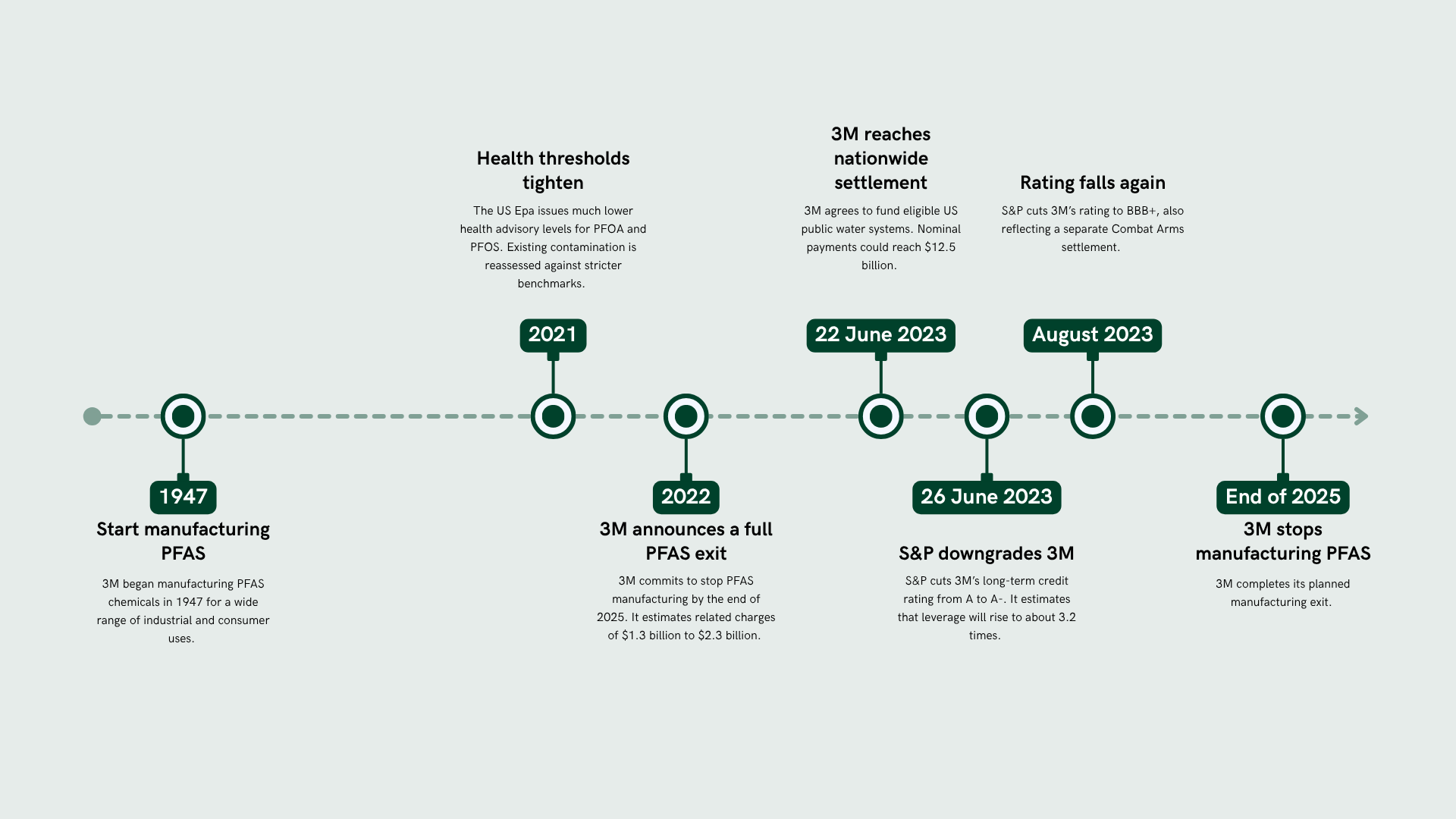
3M began producing PFAS-related chemicals decades ago. Over time, concerns grew about their presence in the environment and the potential consequences of exposure. (3M; US EPA)
In April 2024, the US Environmental Protection Agency established the first national, legally enforceable drinking-water standards for six PFAS. These standards gave public water systems clearer thresholds against which contamination could be assessed and, where necessary, treated. (US EPA)
This illustrates an important feature of nature-related transition risk: the environmental impact may already exist long before regulation changes its financial significance.
As standards tighten, detection improves or expectations change, costs that were previously borne by communities, public authorities or the environment may increasingly be transferred back to the companies associated with the activity.
A settlement does not define the full exposure
The most visible financial consequence for 3M is its settlement with US public water systems, which received final court approval in March 2024. (3M)
Under the agreement, 3M expects to pay between $10.5 billion and $12.5 billion in nominal terms between 2024 and 2036. The company recorded a $10.3 billion accrual, representing the pre-tax present value of those anticipated payments. (3M SEC filing; 3M)
The scale of the charge had an immediate effect on 3M’s reported financial performance. In the second quarter of 2023, the settlement reduced reported earnings by $14.19 per share. The company consequently reported a GAAP loss of $12.35 per share and a GAAP operating margin of negative 107.6%, compared with adjusted earnings of $2.17 per share and an adjusted operating margin of 19.3%. (3M: Q2 2023 results)
The liability also affected 3M’s credit profile. Four days after the public-water settlement was announced, S&P Global Ratings downgraded 3M’s long-term issuer credit rating from A to A- and its short-term rating from A-1 to A-2. S&P estimated that the settlement would increase its measure of 3M’s leverage to approximately 3.2 times, above previous expectations, and noted that the $10.3 billion charge was equivalent to slightly less than two years of the company’s net income. (S&P Global Ratings)
3M’s rating was subsequently lowered further to BBB+ after the company agreed a separate $6 billion settlement relating to Combat Arms earplugs. That later downgrade cannot be attributed to PFAS alone. However, S&P continued to identify the public-water settlement and the prospect of additional PFAS claims as constraints on the company’s credit profile. (S&P Global Ratings)
The connection remains visible today. Fitch rates 3M A-, but states that PFAS exposure has a negative effect on its credit profile and results in a rating below companies with comparable operational and financial characteristics. S&P affirmed its BBB+ rating in 2025, after leverage fell below its downgrade threshold, while still recognising the burden created by continuing legal-settlement payments. (Fitch Ratings; S&P Global Ratings)
The accounting charge represented expected future payments rather than a single-year cash outflow. Nevertheless, the cash consequences are already material. In the third quarter of 2024, 3M reported $3.6 billion of net after-tax payments for significant litigation, primarily relating to the PFAS public-water settlement and the Combat Arms litigation. Those payments contributed to negative operating cash flow of $1.8 billion for the quarter. 3M does not separately disclose the exact PFAS portion of that combined figure. (3M: Q3 2024 results)
The public-water settlement should not be treated as a complete measure of 3M’s PFAS exposure. It addresses a defined category of claims and does not constitute an admission of liability. Other matters—including environmental remediation, state claims, personal-injury litigation and actions outside the United States—may follow different legal processes. (3M SEC filing; S&P Global Ratings)
In 2025, for example, 3M reached a proposed agreement to resolve PFAS-related claims brought by the State of New Jersey. The agreement provides for nominal payments of between $400 million and $450 million, while 3M expected to recognise a $285 million pre-tax charge based on the present value of those payments. (3M; 3M SEC filing)
Strategic consequences beyond litigation
In December 2022, 3M announced that it would exit all PFAS manufacturing and work to discontinue PFAS use across its product portfolio by the end of 2025. It cited accelerating regulation and changing stakeholder expectations among the factors behind the decision. 3M subsequently completed its exit from PFAS manufacturing at the end of 2025. (3M: exit announcement; 3M: completion of manufacturing exit)
The exit itself has created further financial costs. 3M originally estimated total related pre-tax charges of $1.3 billion to $2.3 billion, of which approximately 70% to 80% were expected to be non-cash. These costs include asset impairments and other expenses associated with withdrawing from PFAS manufacturing and changing the company’s product portfolio. (3M: PFAS manufacturing exit)
Ending production, however, does not end the risk. Legacy contamination can continue to generate costs after manufacturing has ceased. Companies may also need to reformulate products, qualify alternative materials and support customers through substitutions.
The case therefore demonstrates how nature-related risk can move through several parts of a business simultaneously: from environmental management and legal liability to earnings, cash flow, creditworthiness, operations and capital allocation.
What other companies should learn
The lesson from 3M is not that every environmental impact will result in a multibillion-dollar settlement. PFAS have an unusually persistent and complex risk profile. But the mechanisms through which the risk developed are relevant far beyond the chemicals sector.
Current regulatory compliance is not necessarily a reliable measure of long-term exposure. Scientific understanding and legal standards evolve, while environmental contamination can remain in place for decades.
Environmental information should inform financial and strategic decisions. Scenario analysis can help management test how liabilities might change under stricter standards, lower detection thresholds, wider claimant populations or more demanding remediation requirements.
The significance of the 3M case lies partly in the gap between when the environmental impact occurred and when its full financial consequences became visible. By the time the risk was reflected in settlements, credit metrics and product strategy, much of the contamination was already embedded across water systems and value chains. That time lag makes persistent pollution particularly difficult to assess—and potentially costly to underestimate.