4 min read

IPBES Report: Biodiversity Loss Is a Business Risk

IPBES Report: Biodiversity Loss Is a Business Risk
7:59

In February, the Intergovernmental Science-Policy Platform on Biodiversity and Ecosystem Services (IPBES) approved its Business and Biodiversity Report, following a three-year assessment by 79 experts from 35 countries and a review by more than 150 governments.

The report examines how businesses depend on and impact biodiversity and nature's benefits to people. It also explores what this means for economic activity, financial stability, and long-term growth. Its conclusions are relevant to companies across all sectors and regions.

At its core, the assessment finds that loss of biodiversity has become a systemic risk to the economy, and business is both a driver of the problem and a critical part of the solution. 


Why This Report Matters

IPBES assessments are designed to inform policy and decision-making by governments, financial institutions and businesses. They are comparable in role to IPCC assessments on climate change.

This is not the first time scientists have warned about nature loss. But this report is different in three important ways.

First, it focuses explicitly on business and finance - not just governments or conservation. This is the first IPBES assessment focused specifically on business. 

Second, it connects biodiversity decline directly to economic and financial risk, rather than treating it as a moral or environmental issue alone.

Third, it is a methodological assessment, fast-tracked to answer the needs of business for guidance on best practice for biodiversity impacts and dependencies assessment.

The assessment will help decision-makers within businesses, guide disclosure requirements, and shape policy frameworks related to biodiversity and nature-related risk.

In other words, this is the kind of report that quietly reshapes expectations, and then appears later in disclosure rules and investor questions.


Four Key Takeaways for Business

Every Business Depends on Nature, and Affects It

Whether it is agriculture, retail, mining, tech or finance, no sector operates independently of biodiversity. Raw materials, water availability, climate regulation and ecosystem services all sit underneath the global economy. All member states recognize this as a “well-established” fact.

At the same time, business activity remains one of the main drivers of biodiversity loss. IPBES describes this decline as a critical systemic risk to economies and human wellbeing.

Current Economic and Financial Flows Contribute to Nature’s Decline

In 2023, around $7.3 trillion of public and private finance flowed to activities with direct negative impacts on nature. Only $220 billion supported conservation or sustainable use of biodiversity. Unfortunately, this is a structural barrier - incentives still reward activities that erode the natural systems the economy depends on.

Methods to Measure Nature are Available, but Uptake is Limited

The assessment finds that the scientific basis for measuring business impacts and dependencies on biodiversity is sufficient to guide action. Despite this, fewer than 1% of publicly reporting companies currently disclose biodiversity impacts in their public reports.

Business Action is Required

IPBES identifies more than 100 actions that businesses, governments and financial institutions can take to address biodiversity loss and create an enabling environment for sustainable outcomes. For businesses, this includes reporting on biodiversity and integrating nature-related considerations into decision-making processes.


The Gap Between Assessment and Implementation

While awareness of biodiversity loss has increased, the report finds that business action remains limited. As previously mentioned, fewer than 1% of publicly reporting companies currently disclose biodiversity impacts in their public reports. Barriers identified to disclosure and action include data availability, complexity, lack of incentives and misalignment between ecological timescales and business decision-making.

IPBES doesn’t deny the complexity of understanding biodiversity impacts and dependencies. But it is clear that waiting for perfect data is no longer defensible. Companies can — and should — act with the information already available.


How IPBES Recommends Companies Decide How to Measure Nature

IPBES proposes three criteria for assessing whether a measurement approach is fit for purpose: coverage, accuracy and responsiveness.

Coverage
Does the method capture the parts of the business and value chain where biodiversity impacts and dependencies are likely to be material? Methods with broad coverage are useful for identifying where risks and dependencies may be material.

Accuracy
How well does the method reflect real ecological conditions? IPBES clearly states that the level of accuracy needed depends on the decision being made. High-level screening does not require site-level precision, but local decisions do. The report cautions against over-interpreting results from methods that cannot reflect local conditions.

Responsiveness
Can the method show whether business actions are making things better or worse over time? This matters for tracking progress, demonstrating credibility and avoiding greenwashing. If a method can’t detect change, it may inform risk awareness, but it won’t support management.


How Natcap Aligns with the IPBES framework

The IPBES assessment emphasises that no single method is suitable for all business decisions. Effective approaches are those that are appropriate to the decision context and meet the criteria of coverage, accuracy and responsiveness.

Natcap designed its approach with this framework in mind.

Coverage:
With over 70 TNFD- and CSRD-aligned metrics, and coverage across more than 200 commodities, Natcap ensures that businesses can measure their interactions with nature, no matter where in the world or in their value chain they occur.

Accuracy:
Natcap combines best-in-class datasets, enabled by broad partnerships with over 30 data providers such as IBAT, with customer data to deliver audit-grade analyses and insights. Natcap understands that data is only useful to the extent it enables decisions. To support this, Natcap enriches raw data with interpretive layers (e.g. concern scores, dynamic explainers, prioritisation heatmaps) to deliver decision-relevant data.

Responsiveness:
Natcap leverages datasets that are able to identify changes in both the state of nature and magnitude of impact over time. For example, Natcap uses Google Dynamic World data to measure annual change in vegetation.


What this Means for Business Leaders Now

The IPBES Business and Biodiversity Report signals a shift in how biodiversity is expected to be considered in economic and corporate decision-making.

For companies, this implies a need to:

  • understand how they depend on and impact biodiversity

  • integrate biodiversity into governance, strategy and risk management

  • and report and act in a way that supports credible outcomes

The assessment indicates that expectations around biodiversity will continue to increase, particularly through policy, regulation and financial markets.


A Quiet Turning Point

The IPBES Business and Biodiversity Report provides a consolidated scientific basis for understanding the relationship between business and biodiversity.

Its findings suggest that addressing biodiversity loss is not only an environmental consideration, but a necessary component of long-term economic and business sustainability.

For business leaders, this moment calls for moving biodiversity out of the background and integrating it into the decision-making process.

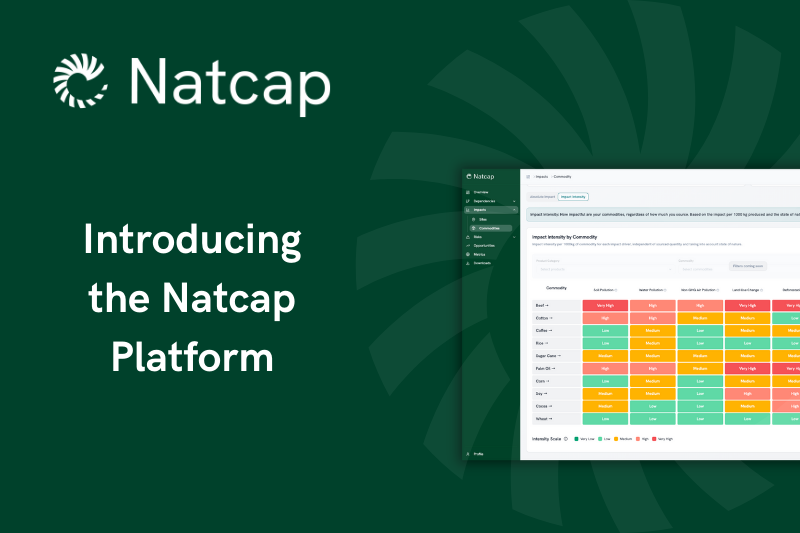
Introducing the Natcap Platform: Turning Nature Risks into Business Intelligence

Introducing the Natcap Platform: Turning Nature Risks into Business Intelligence

Nature is no longer a peripheral sustainability issue. From water scarcity and land-use change to biodiversity loss and tightening regulation,...

Read More
2025 Wrapped: The Year Nature Became Impossible to Ignore

2025 Wrapped: The Year Nature Became Impossible to Ignore

For years, nature-related risk sat in a grey zone - acknowledged, discussed, but rarely acted on. In 2025, that changed. Rules became clearer....

Read More
Bringing Climate and Nature Together: What Integration Means in Practice

Bringing Climate and Nature Together: What Integration Means in Practice

The climate crisis has long been a corporate priority. But the nature agenda, biodiversity, land use, pollution, and water, is now emerging as an...

Read More