Nature Risk is a Supply Chain Risk
For many companies, the most material supply chain risks are no longer geopolitical or operational. They are ecological.From water scarcity and soil...
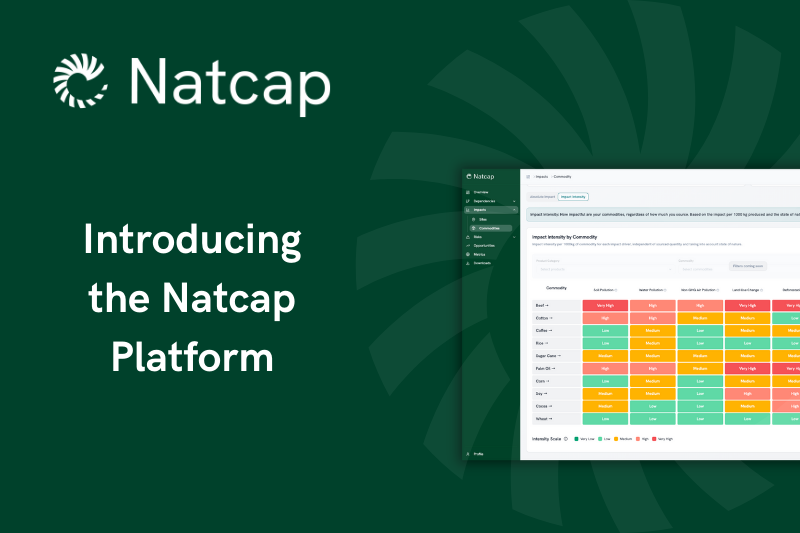
The Nature Tools Compass has identified 74 tools that businesses, financial institutions, and regulators can use to assess their nature-related dependencies, impacts, risks, and opportunities.
The challenge? The Compass itself is more than 250 pages long.
This highlights one of the most common frustrations we hear from Chief Sustainability Officers and sustainability teams: getting started with nature is overwhelming. Knowing which datasets to use, how to combine them coherently, and, most importantly, how to turn complex environmental data into insights that decision-makers can actually act on is hard.
That’s exactly why we built our nature intelligence platform.
Natcap brings together the best available global nature datasets, digests their complexity, and translates them into standardised, interpretable metrics that support TNFD and CSRD disclosures and enable nature-related decision-making. We do this in a way that is secure, scalable, and consistent across global organisations, covering both direct operations and supply chains.
In this blog post, we highlight a selection of the tools featured in the Nature Tools Compass, and explain how we use them in practice.
Natcap uses ENCORE data to identify whether the specific business activities at a site have potential material impacts or dependencies on nature, rating them on a scale from Very Low to Very High. This helps us classify a site as ‘material’ if its activities score highly based on global industry average.
Natcap uses Global Forest Watch data to identify the primary causes of tree cover loss, classifying deforestation into categories such as agriculture, forestry, wildfires, and urbanisation. This global dataset helps to estimate the amount of forest loss linked to each driver, allowing us to understand the specific pressures causing deforestation in a given region.
Natcap uses the Integrated Biodiversity Assessment Tool (IBAT) to access globally recognised data on protected areas, Key Biodiversity Areas, and threatened species ranges. This data allows us to calculate metrics such as Species Extinction Risk and Proximity to Biodiversity Sensitive Areas by identifying how close business sites are to critical habitats and endangered wildlife.
Natcap uses WRI Aqueduct data to identify sites facing high physical water risks, such as water stress, drought, and riverine floods. By analysing this data, we can measure the level of competition for water resources and the likelihood of water-related hazards in a specific area.
We use Google Dynamic World satellite data to map and classify land cover into natural and non-natural land cover, at a high resolution of 10m. Looking at variation over time, we are then able to calculate metrics such as deforestation, land conversion, and the change in amount of natural vegetation, while accounting for the uncertainty in the data.
We use the STAR metric (Species Threat Abatement and Restoration) to evaluate a site’s potential contribution to reducing species extinction risk, specifically through stopping threats (STARt) or restoring habitats (STARr). This allows us to prioritise sites where operations could negatively impact biodiversity or where restoration efforts would be most effective.
By combining datasets like ENCORE, Global Forest Watch, IBAT, WRI Aqueduct, Google Dynamic World, and the STAR metric into a single, coherent analytical framework, we help organisations move beyond data exploration to decision-ready insights. The result is a consistent, defensible view of nature-related risks and opportunities that can be used across reporting, risk management, and strategic planning.
Our nature intelligence platform enables organisations to focus on the more important questions:
Where are our most material nature-related risks?
For many companies, the most material supply chain risks are no longer geopolitical or operational. They are ecological.From water scarcity and soil...
Nature is no longer a peripheral sustainability issue. From water scarcity and land-use change to biodiversity loss and tightening regulation,...
If 2025 was the year nature moved from a “grey zone” of discourse to a business and regulatory imperative, then 2026 will be the year the question...